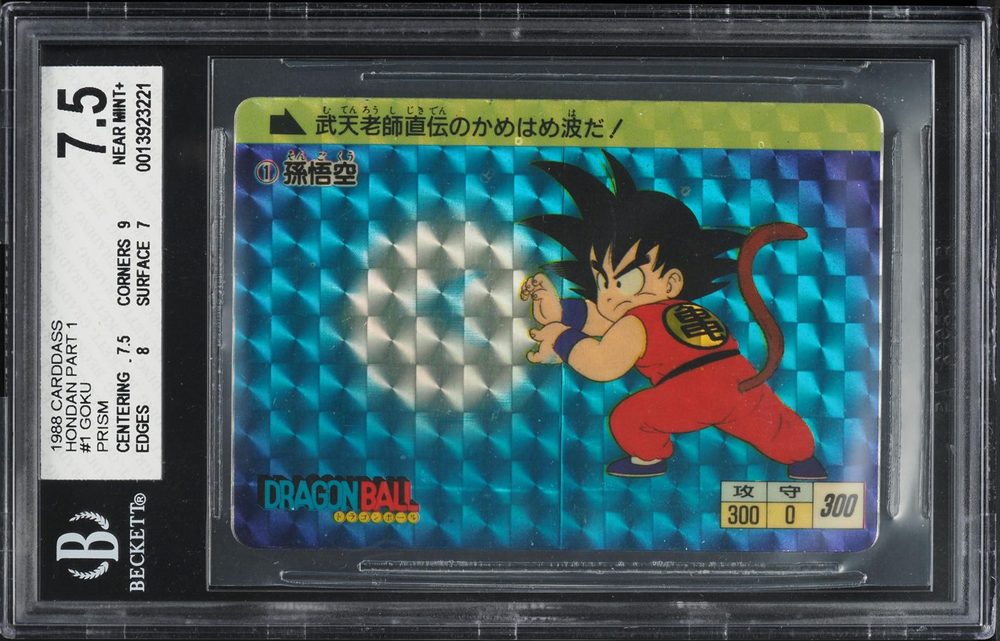
- First
- Nov 1988Dragon Ball Carddass
- Price
- ¥20one card per coin
- Sold
- 2 billion+cards, 1988–1997
- Top lot
- ¥1.5MMechanko Project set
Carddass were Bandai's vending-machine cards, introduced in 1988: one card for a 20-yen coin. Dragon Ball's first Carddass came out in November 1988, and the main series (本弾, Hondan) ran to Part 30 by 1997, with more than 2 billion cards sold in ten years. The true grails, such as the LIMITED3000 lottery cards, never came out of the machines at all.
Last updated . Prices include buyer's premium unless noted.
Cards from a 20-yen machine
Carddass started in 1988 as "Carddass 20": drop a 20-yen coin into a Bandai vending machine, turn the lever and get one card. The first series was Saint Seiya, and Dragon Ball followed in November 1988.[2][3] Bandai later added Carddass 100, five cards for 100 yen.[2] By Bandai's own count, the Dragon Ball main series ran to Part 30 by 1997 and sold more than 2 billion cards in ten years.[1]
Hondan, Super Battle and the rest
| Line | What it is |
|---|---|
| Hondan (本弾), the main series | 1988–1997, to Part 30. 42 cards a part: 36 regular and 6 prisms. 86 × 59 mm. [3][5] |
| Super Battle (スーパーバトル) | 20 parts plus a Special Edition (特別弾) [3] |
| Visual Adventure (ビジュアルアドベンチャー) | 8 parts (5 regular plus SP, '95 and EX), 6 prisms each [3] |
| Jumbo Carddass (ジャンボカードダス) | Extra-large cards. Prism versions were sold one at a time in sealed sleeves. [2] |
| Amada PP cards (PPカード) | Made by Amada, Bandai's rival, and sold in candy shops: pull a paper sleeve for 20 yen. The main line ran to 32 parts. [3] |
The prisms are what collectors chase in the regular sets: six per Hondan part, plus "hidden" prisms such as No.275 Gohan.[3]
The cards that never came from a machine
The most valuable Dragon Ball Carddass weren't sold in machines at all:
- LIMITED3000: Weekly Shonen Jump lottery prizes, 3,000 of each.[8]
- The 1993 "Mechanko Project": a set by Akira Toriyama, 2,000 sets given out through Jump.[6]
- Event and commemorative cards: 究極博 (Kyukyoku-haku) event editions, a "1 billion cards sold" commemorative set, and a 1998 Special Edition Goku limited to 1,000.[3]
What they sell for in Japan
| Card or set | Condition | Price | Where and when |
|---|---|---|---|
| 1993 Toriyama "Mechanko Project" set: 2,000 sets via Weekly Shonen Jump | Set | ¥1,500,000 | Yahoo! Auctions [8] |
| LIMITED3000 card: Weekly Shonen Jump lottery prize, 3,000 made | Raw | ¥1,015,300 | Yahoo! Auctions, 260 bids [8] |
| Mechanko Project set | Set | ¥900,000 | Mandarake, 2021 [6] |
| PP Mini Koro H-3 Krillin (Amada) | — | ¥279,000 | Shop buy price, Mar 2022 [7] |
| 1991 Hondan No.85 prism | ARS 8 | ¥261,000 | Yahoo! Auctions, 24 Oct 2026, 41 bids [9] |
| LIMITED3000 Goku & Gohan | — | ¥205,001 | Mar 2022 [7] |
| 1988 Hondan No.1 | — | ¥110,000 | Yahoo! Auctions, Oct 2026 [9] |
| Visual Adventure SP No.27 Frieza | PSA 10 | ¥100,000 | Yahoo! Auctions, Oct 2026 [9] |
Over the 180 days to October 2026, Dragon Ball Carddass listings on Yahoo! Auctions averaged ¥11,420 across 22,889 results. Most cards are affordable; the grails above are the exceptions.[9]
Japanese graded listings are dominated by ARS, a Japanese grading company, rather than PSA. Expect yen prices and ARS slabs when you shop in Japan.[9]
Reprints that look like originals
- Part 1 was reprinted in 1995 and again in 2008. Check the year printed on the back.[4]
- Bandai's 2015 Reprint Selection booster has 132 cards, 52 of them holograms, drawn from Parts 1 to 8.[1]
- New Parts 31 and 32 (2016) use the original frame and back design.
- Even Sotheby's catalogued a Part 1 Goku prism as "1988 (Reprinted 1995)".[10]
What to search for in Japan
Finding vintage Carddass
Vintage Carddass are everywhere in Japan, so the hard part is finding the right card in the right condition, and not a reprint. Tell us the part, the card number and the grade you want.