- Printed date
- ©1995Pokémon's copyright line
- Sold
- 1997Top Seika's license
- Cards
- 150no Mew
- Holo Charizard
- $228,000PSA 10 · Fanatics · Oct 2026
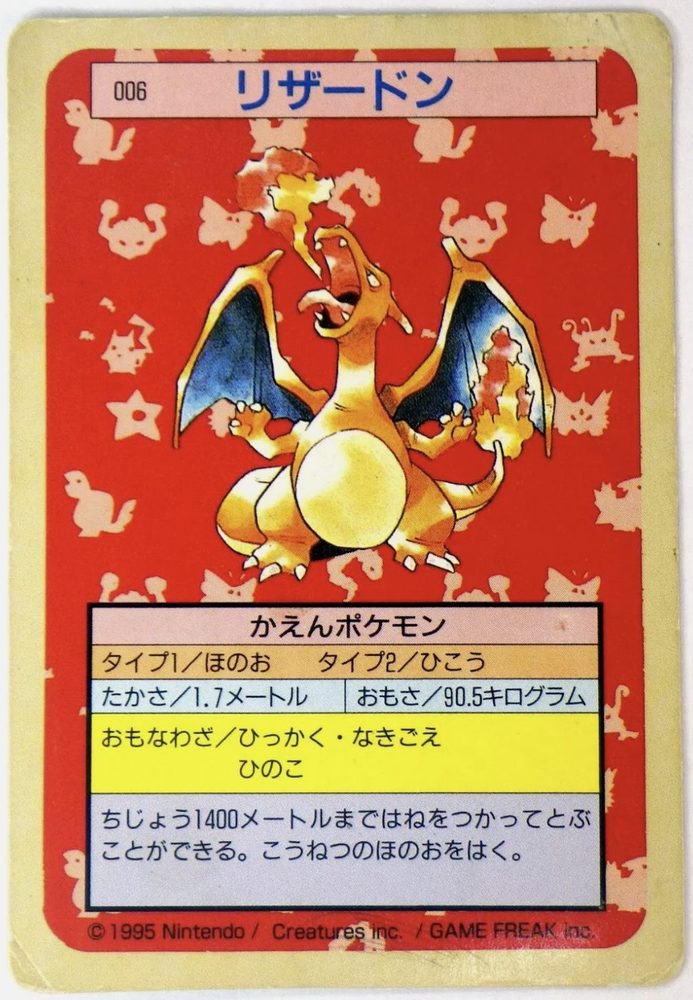
Topsun cards are Pokémon cards sold with apple bubble gum by the Japanese candy maker Top Seika. They carry a ©1995 line, but Top Seika says it got the Pokémon license in 1997, which is when they were sold. The set has 150 Pokémon and no Mew. The most valuable is the holo Charizard: a PSA 10 sold for $228,000 in October 2026.
Last updated . Prices include buyer's premium unless noted.
Bubble gum cards with a 1995 date
In the late 1990s, the Japanese candy maker Top Seika sold Pokémon cards with apple-flavoured bubble gum, two cards to a pack and twenty packs to a box. The set has 150 Pokémon, all drawn by Ken Sugimori, and no Mew.[1][2]
The cards carry a ©1995 line, which is why they're sometimes sold as "the first Pokémon cards". But ©1995 is Pokémon's copyright date, not a print date. Top Seika's own history says it got the Pokémon license in 1997, which puts the cards after Bandai's Carddass (September 1996) and the Base Set (October 1996).[1][10] Some grading labels still say "1995".[2]
They're physically different from trading-card-game cards too: 58.7 × 85.7 mm, smaller than a standard card, and the 16 prism holos are removable stickers.[1]
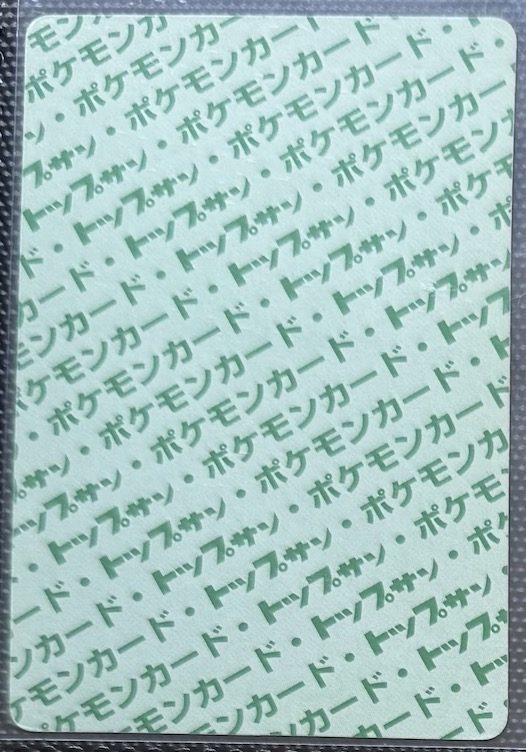
Blue backs, green backs and no numbers
| How to tell | Notes | |
|---|---|---|
| Blue back, no number | Blue back, no card number. Genuine no-number cards have no black border round the title box. | The earliest print and the scarcest. About 50 Pokémon reportedly exist this way (unconfirmed). [5] |
| Blue back, numbered | Blue back with a number, and a black border round the title box | A numbered card without the black border is a fake. [1] |
| Green back | Green back | The later print [1] |
A price ladder that moved both ways
| Card | Grade | Price | Sold |
|---|---|---|---|
| Holo Charizard #6 | PSA 10 | $228,000 | Fanatics Collect, 12 Oct 2026, 62 bids [3] |
| Blue back, no-number Charizard | PSA 10 | $493,230 | Goldin, Jan 2021, when it was pop 1 [4] |
| Blue back, no-number Charizard | PSA 10 | $60,000 | Heritage, 12 Dec 2025 [6] |
| Blue back, no-number Charizard | PSA 10 | $52,800 | Fanatics Collect, 20 Jan 2023 [2] |
| Blue back, numbered Charizard | PSA 10 | $10,000 | Mar 2024 [8] |
| Blue back, no-number Charizard | PSA 9 | $6,500 | eBay, Mar 2025 [7] |
| Blue back, numbered Charizard | PSA 7 | $575 | Heritage, Dec 2025 [9] |
Completed sales, including buyer's premium.
The no-number blue back Charizard shows how fast a market can reset. When it was the only PSA 10 in January 2021, it sold for $493,230; by January 2023 there were three, and one sold for $52,800.[4][2] Meanwhile the holo Charizard went the other way, reaching $228,000 in October 2026.[3]
How to tell a real Topsun
- The no-number Charizard is the most-faked Topsun card. Start with the title-box border rule above.[1]
- Gloss. Genuine non-holo cards are very glossy.[1]
- Corners. Topsun corners are rounder than trading-card-game corners.[1]
- Colour and text. Compare the background, the text box and the Japanese text with a known genuine card.[1]
What to search for in Japan
Finding blue backs
Blue backs still turn up in Japanese auction lots and old collections, often listed only as トップサン. Tell us which card, which print and what grade you're after.