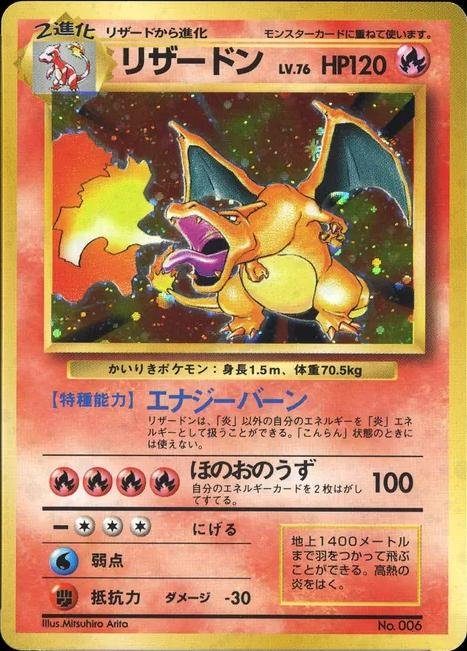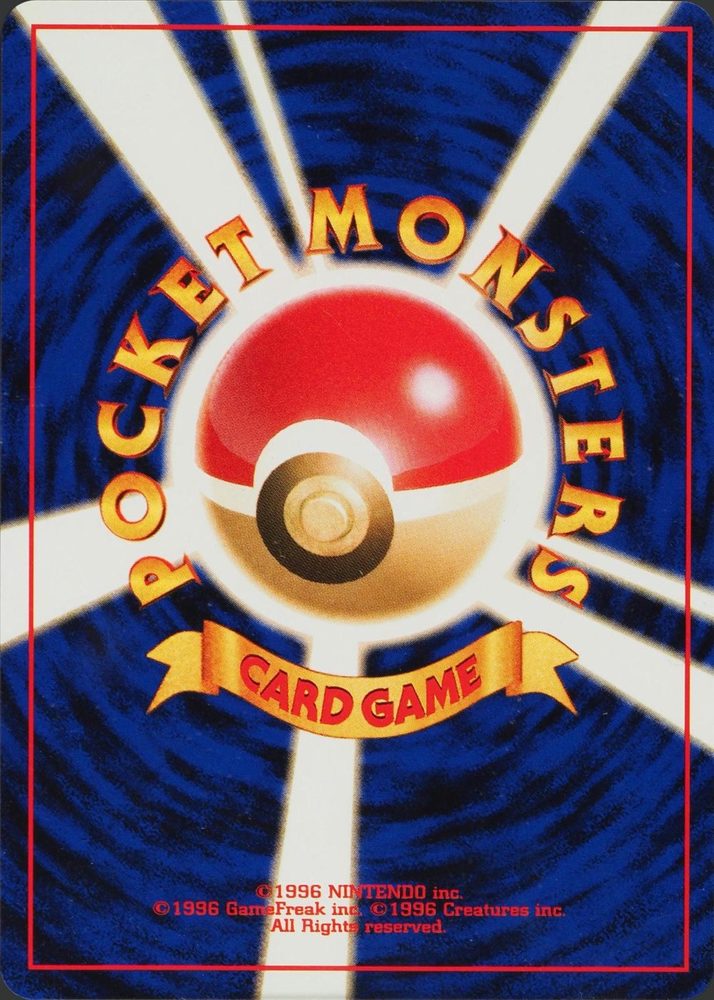
- First cards
- Sep 1996Bandai Carddass
- First TCG set
- 20 Oct 1996Japanese Base Set
- Auction high
- $1.23MNo Rarity Charizard · Goldin · Mar 2026
- The tell
- 70.5 KGNo Rarity Charizard's weight
The first Pokémon cards were Bandai's Carddass vending-machine cards, released in September 1996. The first cards of the Pokémon Trading Card Game came free with CoroCoro Comic's November 1996 issue, on sale 15 October 1996. The first set, the Japanese Base Set, followed on 20 October 1996, and its first print, with no rarity symbol, is the "No Rarity" grail.
Last updated . Prices include buyer's premium unless noted.
The first Pokémon cards, in order
| When | What | Why it matters |
|---|---|---|
| Sep 1996 | Bandai Carddass Pocket Monsters, Part 1 (Green) and Part 2 (Red) | The oldest known Pokémon cards of any kind [1] |
| Sep 1996 | CoroCoro Comic announces the Pokémon card game | The magazine that launched the games launches the cards [2] |
| 15 Oct 1996 | CoroCoro's November 1996 issue goes on sale with Pikachu and Jigglypuff card inserts | The first trading-card-game cards in the public's hands, five days before the first set [3] |
| 20 Oct 1996 | The Pocket Monsters Card Game Base Set: Expansion Packs and the Starter Deck, from Media Factory, 102 cards | The first TCG set. Its first print has no rarity symbol. [1][4] |
| 5 Mar 1997 | Jungle | The first documented rarity symbols [4] |
| 1997 | Topsun gum cards, printed "©1995" | Often called the earliest, but the license came in 1997 [5] |
| 9 Jan 1999 | The English Base Set | More than two years after Japan [1] |
So "the first Pokémon card" has three honest answers, depending on what you mean:
- The first Pokémon card of any kind: Bandai's Carddass vending-machine cards, September 1996.[1]
- The first trading-card-game cards anyone could hold: the Pikachu and Jigglypuff inserts in CoroCoro Comic, on sale 15 October 1996.[3]
- The first set: the Japanese Base Set, 20 October 1996, and its first print, No Rarity.[1]
The first print, and how to spot it
The first print run of the Base Set has no rarity symbol in the bottom right corner, where every later print has a circle, diamond or star. Collectors call it "No Rarity". It came in both the first Expansion Packs and the first Starter Decks; rarity symbols first appear with Jungle in March 1997.[4]
The cards were corrected after the first print, and the corrections double as an authentication check. The clearest is Charizard's stats:[6]
| Charizard | Weight / height on card | Rarity symbol |
|---|---|---|
| No Rarity (first print) | 70.5 kg / 1.5 m | None |
| Later Japanese prints | 90.5 kg / 1.7 m | Star |
The stats were corrected after the first print, which makes them a quick check against a later card with its rarity star scraped off.[6]
The main fake is a later print with its rarity star carefully scraped off. If the stats don't match, it isn't No Rarity.
How few survive in high grade
| Grader | Grade | Copies | As of |
|---|---|---|---|
| PSA | 10, No Rarity | 8 | Jun 2024 [9] |
| PSA | 9, No Rarity | 43 | Jun 2024 [9] |
| PSA | 10, later print | 810 | Jun 2024 [9] |
| CGC | All grades, No Rarity | 123 | Jan 2026 [11] |
Next to the later print, the high grades are thin: 8 PSA 10s for No Rarity against 810 for the rarity-symbol print, as of June 2024.[9]
No Rarity Charizard sales
| Date | Grade | Price | Venue | Notes |
|---|---|---|---|---|
| 26 Oct 2026 | PSA 8 | $152,500 | Goldin | Reported. [8] |
| 7 Mar 2026 | PSA 10 | $1,232,200 | Goldin | In a case signed by Mitsuhiro Arita. [7] |
| 3 Mar 2026 | PSA 10 | $1,700,000 | Private sale | Reported, no public record. [7] |
| 13 Sep 2025 | PSA 10 | $641,721 | Goldin | [8] |
| 21 Jun 2024 | PSA 9 | $29,700 | Fanatics Collect | [9] |
| Sep 2023 | CGC 10 | $57,500 | Heritage | [10] |
| Sep 2022 | PSA 10 | $264,000 | Heritage | [10] |
One oddity: the Goldin copy in a case signed by the card's artist, Mitsuhiro Arita, sold for $1,232,200 days after an unsigned PSA 10 was reported sold privately for $1.7M.[7] A signature doesn't automatically add value.
What to search for in Japan
Finding a first print
No Rarity cards were sold in Japanese shops in 1996, so most surviving copies are in Japan, and many are still raw. Tell us which card and grade you're after. Charizard is the headline, but it isn't the only No Rarity card collectors chase.